Perry Design Review: Electra Sport 20
A dinghy for dignified speedsters
The variety of boats available never ceases to amaze me. As I take my lunchtime walk to exercise my dog, I peruse the transoms lined up in the marina and marvel at the divergent approaches to shape and proportion. There are volume boats, i.e. cruisers, of which I have designed a few, as well as the beaten-up, racer-cruiser types and the strictly performance-oriented designs. It's good to have respect for and an understanding of the qualities of each type, but I always find myself drawn to the performance end of the scale. I hate to be passed.
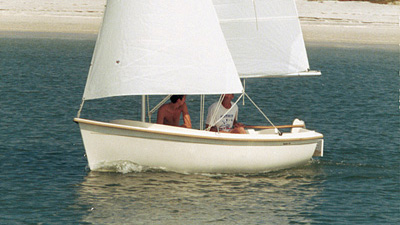
Hubert Raudaschl of St. Wolfgang, Austria, and Heider Funck of Toronto, both sailmakers and designers, collaborated on the design of the Electra Sport 20. They were helped in the design by George Nissen. The target for this design was master sailors who have found the physical side of Laser sailing too undignified — well, that's how I'm going to word it. In many ways this design reminds me of another boat I owned, the Wylie Wabbit. The Wabbit was very exciting to sail, extremely wet and oftentimes just plain scary. It was not self-righting, despite the 400-pound lead keel. I wonder, what's the use of a keelboat that isn't self-righting?
So, what is self-righting? If you take a knockdown you would like to come back up and not just lay on your side. The Electra has 20 pounds of righting moment at 90 degrees. The big variable here is the location of the crew weight. When I took my first knockdown in my Wabbit, Chuck and I stayed in the cockpit while our friend "Twice Around" Ted had the sense to climb over the side and stand on the fin keel, Laser-sailor style. It was only when Twice Around Ted got his weight out on the keel that we slowly began to come back up. Is that self-righting? It wasn't to me at the time.
The question for the designers is just how to divide the personality of the boat between speed and ease of handling. I think the designers of the Electra chose to make this a boat that would appeal to the experts and ex-dinghy sailors who are comfortable with sailing on the edge. If you added more lead, you would only slow the boat down.
Two versions of the keel are available. The first is a fixed keel with 3 feet, 4 inches of draft and 300 pounds of lead. The second is a drop-style fin with 4 feet, 1 inch of draft and a bulb at the end. This will further increase the righting moment of the Electra.
The hull shape shows narrow beam at waterline (BWL) and a tangent at centerline. The canoe body profile shows the hull flattened off around the keel and running straight, with even a slight hint of hollow as it goes aft. It is an unusual rocker shape. Perhaps it was derived from the area rule where you try to maintain a smooth curve of areas in the way of the additional keel volume, i.e. the coke bottle approach.
The SA/D of this speedster is 34.77. If you add the weight of two crewmembers — say 325 pounds — to the published displacement of 850 pounds, you get an SA/D of 27.63. The rig has been undergoing revision and fine tuning in order to find the right combination of main size and shape and jib-genoa combination.
This design looks like it would be fun to sail. The cockpit sides are beautifully curved for comfort while hiking, and there is a rigid pipe bar to hook your feet under. The cuddy is sufficient for two to sleep. All in all this is a hybrid between keelboat and dinghy that should attract a lot of sailors too dignified for the antics required to keep a Laser on its feet.
Boat Specifications
| LOA | 20' |
| Beam | 6'4" |
| Draft | 3'4" |
| Displacement | 850 lbs. |
| Ballast | 300 lbs. |
| Sail Area | 205 sq. ft. |
| SA/D | 34.77 |
| D/L | with 350-lb. crew 78.1 |
| L/B | 3.17 |
| Auxiliary | 2-horsepower Nissan. |
 This story originally appeared in Sailing Magazine, and is republished here by permission. Subscribe to Sailing.